
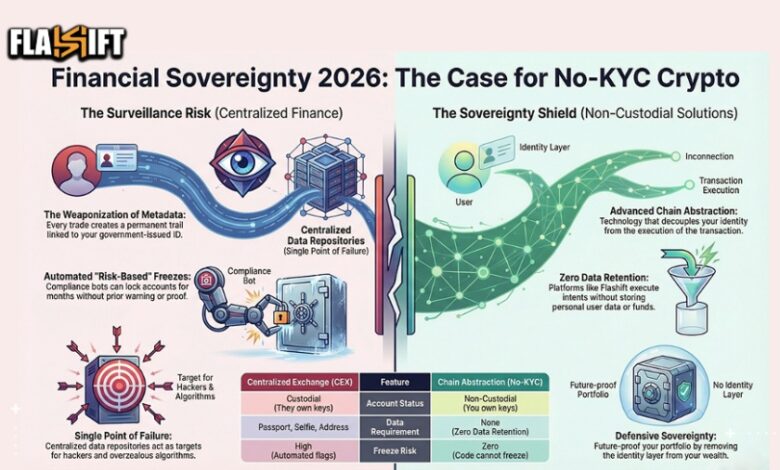
The most fundamental decision a crypto investor makes is not what to buy, but how to hold it. The debate between Custodial (Centralized) and Non-Custodial (Decentralized) trading has raged for a decade, but in 2026, the verdict is becoming increasingly clear.
Following the regulatory crackdowns and exchange insolvencies of the mid-2020s, the market has learned a hard lesson: convenience often comes at the cost of ownership. This comprehensive guide analyzes the structural risks of both models and explains why the smart money is migrating toward aggregation layers.
The Custodial Model: Convenience with a Catch
A Custodial Exchange (CEX) like Coinbase or Kraken operates like a traditional bank. When you create an account, you do not get a crypto wallet; you get a database entry. The exchange holds the private keys, and they promise to give you your money when you ask for it.
- The Advantage: High speed, easy fiat onboarding (connecting a bank account), and customer support if you forget your password.
- The Fatal Flaw: You are a creditor. If the exchange is hacked, goes bankrupt, or decides to freeze your account due to a “compliance flag,” you have zero recourse. Your assets can be seized with a single click. In 2026, “Risk-Based Blocking” has made this a daily reality for thousands of innocent users.
The Non-Custodial Revolution
Non-custodial trading creates a direct connection where you trade directly from your own wallet (like Ledger, Trezor, or MetaMask).
- The Advantage: Sovereign ownership. No one can freeze your wallet because you hold the keys.
- The Distinction: It is crucial to understand that a platform can be Non-Custodial without being fully Decentralized. Services like aggregators operate centralized software to find you the best route, but they process the trade without taking custody of your funds. You trust the execution, but you never surrender ownership.
How Chain Abstraction Bridges the Gap
The reason non-custodial trading has exploded in popularity in 2026 is a technology called Chain Abstraction.
In the past, trading across chains non-custodially required complex bridging knowledge. Today, platforms like Flashift use AI to abstract this complexity. The user experience is now identical to a CEX—simple, fast, and intuitive—but the backend remains strictly non-custodial.
This technology allows users to swap Bitcoin for Monero, or USDT for Kaspa, without ever depositing funds into a third-party wallet. The aggregator acts as a search engine and a router, but never as a custodian.
Comparative Analysis: Feature by Feature
Let’s look at the data. Here is how the two models stack up in the current market environment:
| Criteria | Custodial Exchange | Aggregator (Non-Custodial) |
| Security Model | “Trust Me” (Centralized Custody) | “Pass-Through” (Non-Custodial Execution) |
| Privacy | Zero (Full KYC Required) | High (Minimal Data Retention) |
| Liquidity | Limited to Internal Orderbook | Global (Aggregated Sources) |
| Regulatory Risk | High (Asset Seizure) | Low (Refund-Oriented Policies) |
| Fee Structure | High Withdrawal Fees | Transparent Network Fees |
The Privacy Imperative
We cannot discuss custody without discussing privacy. Custodial exchanges are the primary surveillance nodes of the crypto ecosystem. They link your on-chain activity to your physical identity, creating a permanent record of your wealth.
A non-custodial Crypto Exchange Aggregator respects the original ethos of cryptocurrency. It validates the transaction, not the person. For traders who value their financial privacy—whether to protect against hackers or simply to keep their net worth private—this is the only viable option.
Conclusion: The Future is Self-Sovereign
The era of trusting third parties with your life savings is ending. The technology now exists to trade with the speed of a NASDAQ order book while maintaining the security of a cold-storage vault.
By choosing a non-custodial aggregator, you are not just choosing a trading platform; you are choosing a security philosophy. In 2026, the safest exchange is the one that never holds your money.
